Geometry
The schematic below illustrates the experimental geometry employed in the xRHEED package:
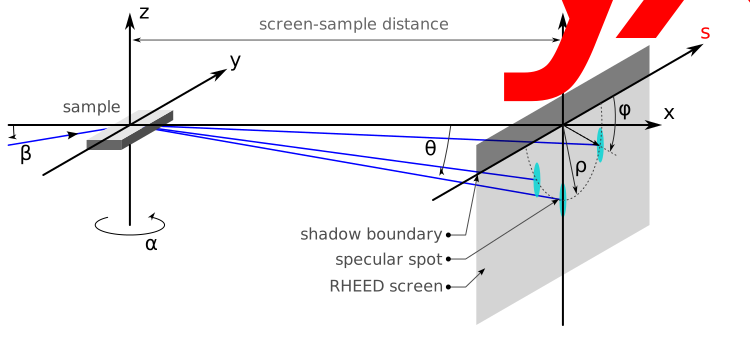
The geometry is described using a primary laboratory Cartesian coordinate system together with a secondary, spherical-like angular parametrization.
Primary coordinate system
The global laboratory coordinate system is Cartesian and right-handed:
\(z\) points upward and is anti-parallel to the sample surface normal (the sample surface faces downward),
\(x\) lies in the horizontal plane and points from the sample toward the screen,
\(y\) completes the right-handed system.
Incident angle
\(\beta\) is the incident angle (also referred to as the glancing angle) between the incoming electron beam and the sample surface plane.
Azimuthal sample rotation
\(\alpha\) is the azimuthal angle, describing a rotation of the sample about the global \(z\) axis.
Positive \(\alpha\) follows the right-hand rule.
This rotation is independent of the diffraction-angle parametrization described below.
Spherical-like diffraction angles
The diffraction directions are parametrized using the angles \(\theta\) and \(\varphi\) in a spherical-like coordinate system that is not identical to standard spherical coordinates.
In this parametrization:
the global \(x\) axis plays the role of the polar axis (analogous to \(z\) in conventional spherical coordinates),
\(\theta\) is the polar angle measured with respect to the \(x\) axis,
\(\varphi\) is the corresponding azimuthal angle measured in the plane spanned by the global \(y\) and \(z\) axes.
Thus, \(\varphi\) lies entirely in the \(y\!-\!z\) plane.
Screen geometry and coordinates
The screen plane is perpendicular to the global \(x\) axis.
The screen coordinate \(S_x\) is parallel to the global \(y\) axis, and \(S_y\) is parallel to the global \(z\) axis. Therefore, for a sample facing downward, the RHEED image is typically defined for negative \(S_y\) values only, with \(S_y = 0\) corresponding to the shadow boundary.